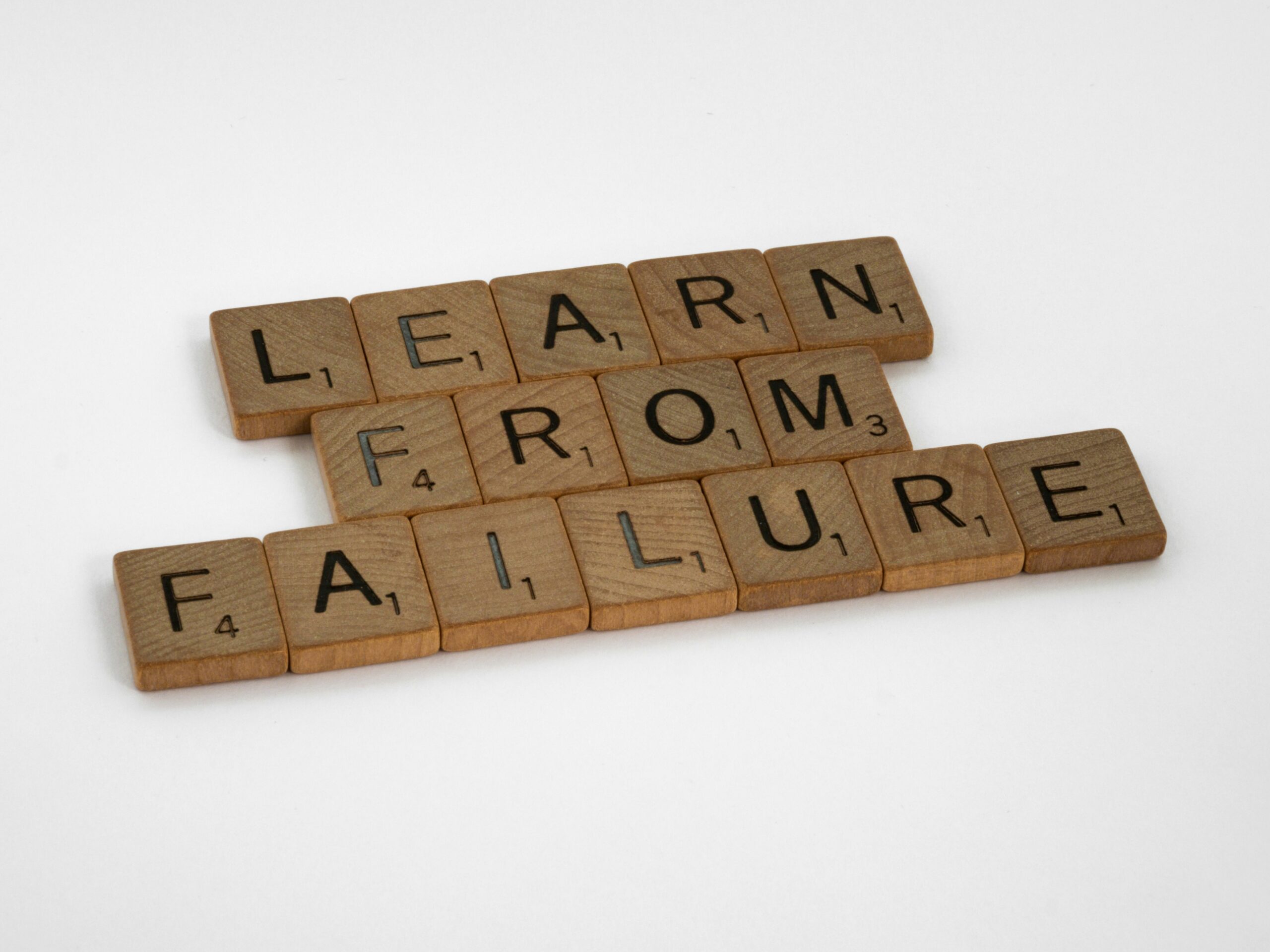
Science must inevitably fail to achieve discovery. This is not a flaw in the scientific method, it is the mechanism behind it. You design an experiment to test an idea, collect and objectively analyse the data, and if the results do not confirm your hypothesis, that outcome is not a failure. It is information that tells you what needs refinement before the next attempt.
The application of this principle beyond a scientific setting is more powerful than it might seem.
Most of my clients are going through major life or professional transition and are considering starting over, abandoning old paths for new ones. If you have been there, you know how daunting this can feel (I have been there myself). The fear of making a wrong move is paralysing. The fear of regret can hold you in endless circles of what-if loops.
But what if you could see your transition as a sequence of small testable steps? Where a test that doesn’t go as hoped is not a failure, but rather key information to understand what works and what doesn’t for you?
Last week, a client contemplating a professional pivot described how, whenever she tried to focus on her plans and action steps related to her career move, her energy and motivation would drop and she could not accomplish anything.
At some point during our conversation, she was reasoning about something she could try and said: what if it doesn’t work? I told her, if it doesn’t work it’s not a failure, it’s information.
I told her, “If it doesn’t work, it’s not a failure. It’s information“
This completely changed her narrative. Her struggle was not a concentration issue; it was her fears blocking her progress. The moment she gave herself permission to fail, she realized the true informative power that failure carries, and she started to move forward. When we reframe failure as data rather than judgment, progress begins to unfold.

The science of productive failure
This is not just a coaching observation. The evidence behind it runs deep. The importance of experimenting in client or patient work is largely based on Cognitive Behavioural Therapy (CBT), where the therapist and the patient identify the patient’s negative prediction or belief and collaboratively design an experiment to challenge its validity. Scientific evidence clearly shows that the effects of this experiential approach can be stronger than challenging people’s beliefs using verbal techniques, such as exposing people to logical flaws in their thought process.
Neuroscientific research points in the same direction.
Our brain constantly generates prediction errors, meaning, the mismatch between predicted and actual outcomes. If, say, we expect something positive but something negative occurs (or vice versa), prediction errors are updated and this is associated with adaptive mechanisms in neurons (especially in the midbrain) and in our behaviours. This means that experimentation and exploration, even when it leads to unwanted outcomes, provides information for improving future decisions, reinforcing neural pathways that make us better prepared for future challenges..
In education research, Manu Kapur illustrated in a series of experiments how failure can actually be conducive to improvement. His research shows that students who are initially given vague, suboptimal instructions to solve a complex problem actually perform better on subsequent challenges than those who are given hints and guided toward the correct answers. Stumbling through the initial friction forced them to build deeper reasoning skills, proving that what looks like a failed attempt is often exactly what determines better, future decisions. Kapur named this concept productive failure.

Reframing the defeat
Across psychology, neuroscience, and education research, the evidence points in the same direction. Failure is essential for growth,
We see this exact mechanism play out in high performance. Interviewed after a bruising defeat at the 2025 Roland Garros, Jannik Sinner noted, “After tough losses I try to go through and then trying to understand what I can do better.” He was essentially describing a conscious update of his own prediction errors. By leaning into the data of that loss rather than treating it as a personal verdict, he went on to win Wimbledon just a few weeks later.
When we look through this lens, the pressure to make a flawless move disappears.

From stall to progress
The good news is that this shift in perspective is something you can begin practising immediately, starting with two small changes:
1. Shift from verdict to data collection
After a setback or a step that didn’t go as planned, your natural instinct might be to blame yourself or see it as proof that you shouldn’t have tried. Instead, try to look at it with the neutrality of a scientist. What specific information did that outcome give you?
2. Lower the stakes with micro-experiments
When a decision, or major change feels massive and permanent, the fear of regret can completely paralyze you. The antidote is to break that huge leap down into tiny, low-stakes tests. Treat your next few steps not as final decisions, but as quick experiments designed solely to gather information. If a micro-test doesn’t work out, you haven’t failed; you have simply narrowed down what doesn’t work for you.
Finding yourself stuck in a circle of overthinking?
Let’s discuss how working together could help you. Contact me or arrange a complimentary 60-minute consultation call.

About the author
Dr Giulia Galli. An accredited coach, chartered psychologist, and academic neuroscientist with twenty years of experience in understanding people’s thinking, decisions and behaviour. You can read more about my story and my approach to coaching here.