
When I was contemplating leaving academia, the thing I was most scared of losing was my title. When somebody asked what I did for a living, replying “I am a professor” felt as if those three words automatically placed me on a pedestal and protected me from judgement. The thought of losing the title made me feel less valuable. Exposed, even. It feels unjustified when I think about it now, but that’s how it felt at the time.
Rationally evaluating what you stand to lose from a major change is sensible. The problem begins when attention to losses becomes so disproportionate that it obscures the possibility of gains entirely. For instance, when the thought of losing my title made it difficult to imagine a more fulfilling career.
In psychology, this is called loss aversion: the tendency to overweigh the impact of losses compared to gains when making decisions. First introduced by behavioural economists Kahneman and Tversky, it was demonstrated in studies showing that people tend to accept a 50:50 gamble only when the potential gain is at least twice the potential loss. Simply put, people prefer not to lose £10 more than they want to find £20. Because this is not a rational preference, loss aversion is considered a cognitive bias, just like the sunk-cost bias I described in a previous post. Its reach extends well beyond economics, into time, status, identity, and opportunity.
Loss aversion and professional transitions
When applied to professional transitions, loss aversion operates across several dimensions. There are tangible losses: salary, job security, physical routines disrupted by a new commute or altered hours. There are relational losses: leaving colleagues, familiar workplace dynamics, the comfort of a culture you already understand. A client of mine who recently moved companies described the loss of that familiarity as losing a privilege, replaced by the constant effort of learning new colleagues, new expectations, new unwritten rules.
And then there are the intangible losses, often the most powerful. Status. Identity. The version of yourself that a particular role or institution has conferred.
If you are considering a career change, it is entirely reasonable to be afraid of losing those things. Some clients chose to decline opportunities with substantial financial gain because the non-financial losses feel too significant. And when the choice came from genuine awareness rather than hidden bias, they have never regretted those decisions.
The problem is when the fear of loss operates below the level of awareness, keeping you from doing a genuine evaluation of losses and gains. Consider the math of an average career: in the UK, a full-time employee works roughly 1,800 hours a year. If most of those hours are spent in chronic dissatisfaction or burnout, staying in place carries its own massive loss. The question worth sitting with is then what non-functional aspects of your current role you are willing to let go and weigh this against the benefits of transitioning into a more fulfilling career.
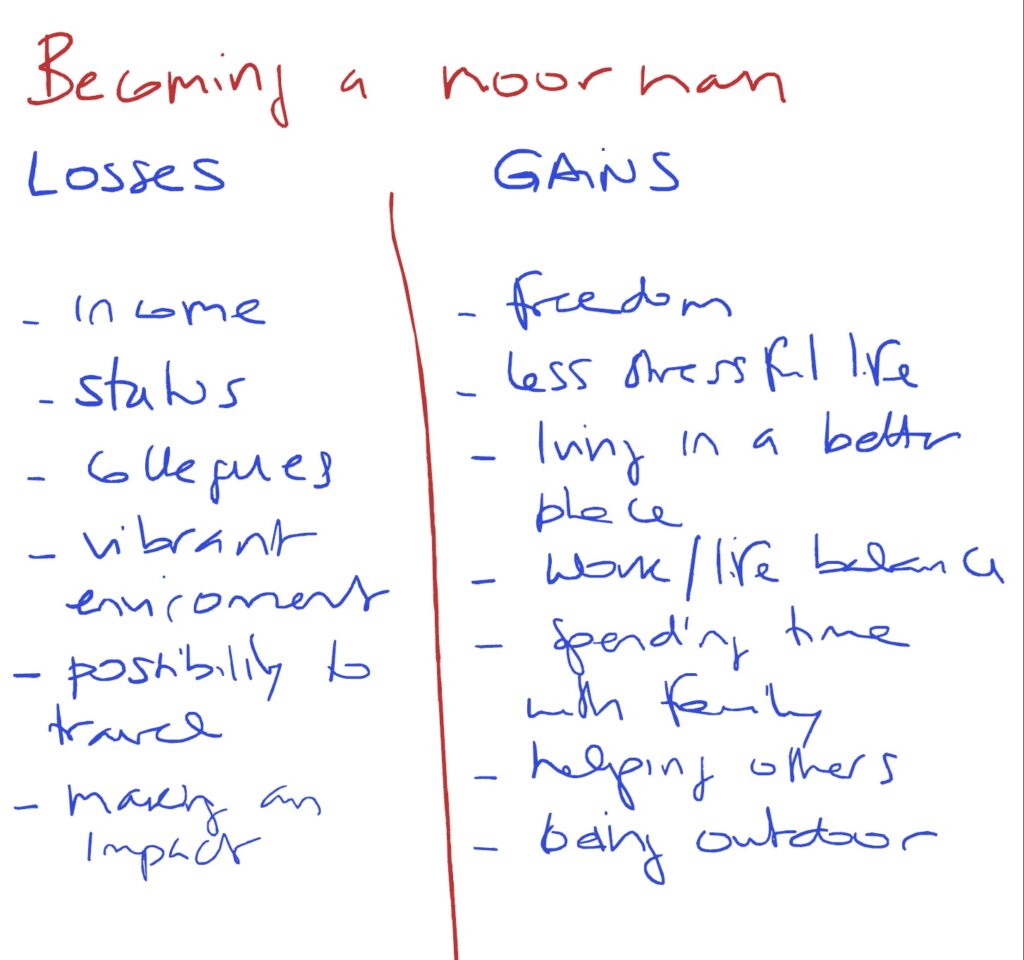
A client of mine recently left his academic position to become a mooring man in his coastal hometown. Much of our work together involved making visible what he feared losing and what he stood to gain. When he fully recognised his deep need for freedom and a simpler life, the loss-gain calculation shifted entirely. The losses did not disappear, but the gains became the driving force once he recognised how fundamental freedom and a simpler life were to who he actually was.

The psychological and biological roots of loss aversion
When evaluating potential losses, people tend to predict that the pain of losing will outweigh the pleasure of an equivalent gain. Neuroscientific findings mirror this asymmetry. The amygdala, a brain region central to the anticipation of aversive events, shows stronger activation in response to potential losses than to equivalent gains. Research by neuroscientist Elisabeth Phelps and colleagues also found that the anticipation of losses, compared to gains, produces stronger physiological arousal responses. Loss aversion, in other words, is not purely a failure of rational thinking. It has a distinct biological basis.
What makes this particularly relevant to major life decisions is a finding by psychologist Deborah Kermer and colleagues: loss aversion tends to be far stronger in anticipation than in actual experience. People systematically overestimate how painful a loss will feel. When a loss eventually occurs, coping mechanisms activate and help us minimise or reframe it. The feared loss rarely feels as devastating as it did in prospect.
My own experience is a clear illustration of this. The loss of my title has been far less painful than I anticipated. Although it took me time to adjust my new professional identity, I realised that my title and my academic career were ‘locking me in’ (I discussed the concept of locked-in personality in one of my previous blogs). Now, introducing myself as a coach, a neuroscientist, a psychologist, or a consultant, depending on the context, gives me much more joy than introducing myself with “I am a professor”. The title is no longer relevant for me, what matters is the fulfillment I have found since.

What to do if loss aversion is keeping you stuck
In high-achievers, loss aversion is often a sign of how much has been successfully built. The difficulty is that this protection can become a deadlock, when the psychological weight of potential loss feels so much greater than the possibility of gain that no decision feels safe.
A useful starting point is to ask what the realistic worst-case outcome would be if you made the change you are considering. Usually, this helps put loss into perspective. It may also be helpful to rationally think if the losses you fear are objective and real, or only perceived as such. As the research by Kermer and colleagues shows, our capacity to cope with loss is far greater than we predict. Reminding yourself of this resilience makes it easier to evaluate your options rationally before deciding.
An exercise I use with clients for this is what I call the Symmetry Test. Start by identifying one decision you are currently weighing and list the specific things you are afraid to lose if you make that choice. Then, for each loss, identify a symmetric gain: a concrete opportunity, freedom, or state that the same move would create. Finally, ask yourself one question: if you knew with reasonable confidence that the gain would materialise, would the loss still feel significant enough to stop you?
Want an email every time I publish a new blog post? Drop your address below.
Finding yourself stuck in a circle of overthinking?
Let’s discuss how working together could help you. Contact me or arrange a complimentary 60-minute consultation call.

About the author
Dr Giulia Galli. An accredited coach, chartered psychologist, and academic neuroscientist with twenty years of experience in understanding people’s thinking, decisions and behaviour. You can read more about my story and my approach to coaching here.