
You may have built your career on your ability to navigate complexity and make high-stakes decisions for your team or your loved ones.
So why, when it comes to your own next chapter, have you hit a wall? Why has that same sharp, analytical mind gone quiet, or worse, started circling the same options in an endless what-if loop?
Before we look at why this happens, let me offer some reassurance that may reframe how you see your situation. Psychological research draws a useful distinction between indecisiveness, the chronic inability to make decisions across contexts, and indecision, meaning difficulty making decisions in a specific area. You may have excellent decision-making abilities when it comes to your team, your family, or high-stakes professional calls, and yet struggle when it comes to major life decisions for yourself. For many high achievers, this is entirely consistent with how their analytical mind works under conditions of deep personal uncertainty.
Based on empirical research and my experience with coaching high-achievers, there are three main reasons why intelligent professionals overthink major decisions:
Intolerance of uncertainty
One of the most consistent patterns I observe in high achievers stuck at a crossroads is intolerance of uncertainty. In most professional contexts, you can rely on accumulated experience and expertise and navigate complex decisions seamlessly. Major life decisions are different. They involve a degree of personal uncertainty that experience alone cannot resolve, and for someone accustomed to making confident, informed calls, that uncertainty can be deeply uncomfortable.
Research consistently links intolerance of uncertainty to decision-making difficulties. Clinical Psychologist Ravi Sankar notes that in an attempt to regain a sense of control of uncertainty, people tend to adopt one of two strategies. Some over-engage, seeking more information, running more scenarios, and investing disproportionate effort in finding the perfect answer. Others under-engage, either making an impulsive choice to end the discomfort of waiting, or defaulting to inaction altogether.
In my experience working with high achievers at crossroads, the majority fall into the first category. They are exhausting themselves trying to make the decision flawless.

Perfectionism
Closely connected to intolerance of uncertainty is perfectionism. Psychologists have consistently found that indecision is often a product of perfectionist thinking. Perfectionists are scared of making the wrong choice, and so they put off making decisions until they feel certain. When the bar is set at certainty, and certainty is unavailable, the decision simply does not get made. The information gathered is never quite enough, and the analysis continues indefinitely.
For high achievers, this pattern can be particularly entrenched. A career built on precision, thorough analysis, and informed choices trains the brain to treat the unknown as a threat to be neutralised rather than a condition to be navigated. Their internal risk-mitigation system is demanding a level of data that does not exist and can only be arrived at through experience.

Decision fatigue
The more decisions a person makes across a day, the more their capacity for careful, considered judgment depletes. For high achievers carrying significant professional and personal responsibility, this depletion is often chronic rather than occasional. A 2023 survey of over 14,000 business leaders found that 74% reported the number of daily decisions they face had increased tenfold over the previous three years.
What makes decision fatigue particularly relevant here is its effect on emotional clarity. Research by Eckland and collaborators suggests that the ability to accurately identify one’s own needs and emotions plays a significant role in reducing indecision. When fatigue sets in, that clarity is precisely what becomes hardest to access, leaving the analytical mind to work harder in compensation, which compounds the problem further.

What happens in the brain of high-achieving professionals during complex decisions
Understanding what happens in the brain during complex decisions helps explain why these three patterns are so resistant to purely analytical solutions, and why high achievers in particular can find themselves genuinely stuck despite their cognitive ability.
Decision making relies on a dynamic interplay between the prefrontal cortex, the part of the brain responsible for reasoning, planning and impulse control, and the striatum, which processes the anticipated value and reward of different options. Together, these structures weigh up the expected outcomes of each choice and move us toward a decision. The prefrontal cortex is precisely the area that years of analytical training and high-stakes professional experience develop most extensively.
The critical point is this: when we are operating under chronic stress, fatigue, or emotional conflict, the communication between these two areas becomes disrupted. The prefrontal cortex loses some of its ability to integrate the emotional and values-based signals that complex personal decisions require. For high achievers, this creates a specific and frustrating paradox. The very cognitive machinery that has served them well professionally becomes insufficient for the kind of decision they are now facing, not because it is weak, but because personal crossroads demand a different quality of input than professional ones.
What the research suggests you can do differently
Each of the patterns described above points toward a specific intervention rather than a general mindset shift. Before addressing each one, it is worth considering the frame within which any intervention works best.
Expand the dimensions of your thinking rather than the depth of one
There is an important distinction between overthinking and what might be called productive thinking. Overthinking typically means cycling repeatedly through the same dimension of a decision, most often the practical or strategic one. What would the career move look like financially? What opportunities would it open or close? This kind of circular analysis rarely resolves the impasse because it is applying more pressure to the same point.
Productive thinking means deliberately distributing your attention across the multiple dimensions that complex personal decisions involve. This is the foundation of my 5D FrameworkTM, which approaches decision-making across five distinct dimensions: identity, values, emotion, relationships, and strategy.
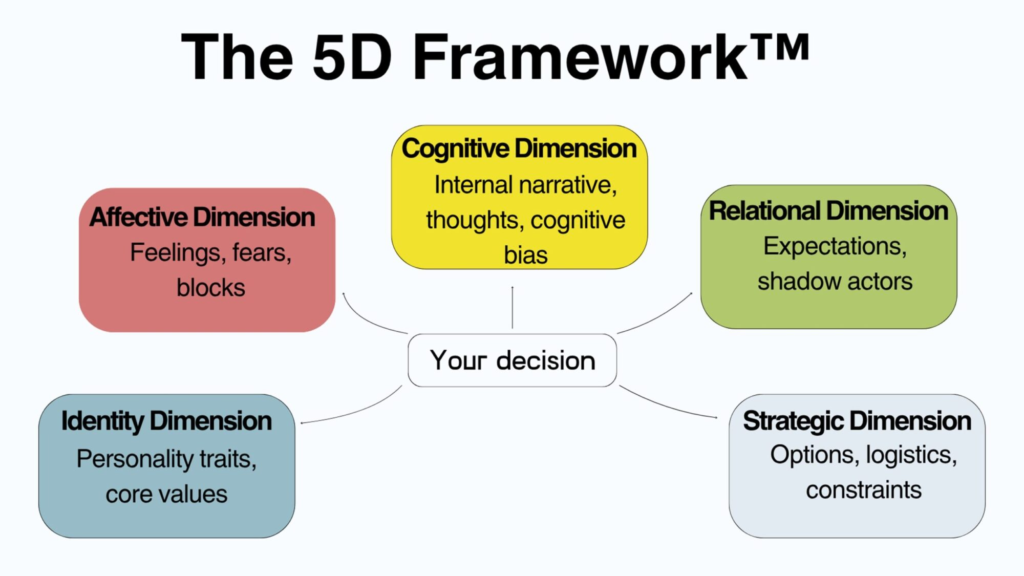
In my work with clients, expanding the frame of the decision in this way consistently proves more effective than deepening the analysis of any single aspect. Complexity deserves a multidimensional response, not an increasingly detailed answer to a single question.
If intolerance of uncertainty is driving your loop
Rather than attempting to eliminate uncertainty, the goal is to build a graduated tolerance of it. In practical terms this means deliberately constraining your options and your timeframe. Give yourself a defined set of alternatives and a fixed window to decide. The discomfort this produces is precisely the point. Tolerating it in low-stakes contexts builds the capacity to do so when the stakes are higher.
If perfectionism is sustaining the impasse
Perfectionism in decision-making is maintained by the belief that a zero-risk option exists and can be found with sufficient analysis. A useful reframe is to shift the question from what is the right decision to what is the cost of not deciding. The opportunities foregone, the mental energy consumed, and the narrowing of options over time are all concrete data points that perfectionist thinking tends to discount.
If decision fatigue is compromising your clarity
Research on emotional clarity suggests that the ability to accurately identify your own needs and values is one of the strongest predictors of decisive action. When fatigue is high, that access is compromised. Protecting the conditions under which you make significant personal decisions, time of day, cognitive load, emotional state, is not a peripheral concern. It is a direct intervention on the quality of your decision-making process.
And if all three are present
Which in my experience they frequently are, the most important shift is recognising that more analysis will not resolve the impasse. The information you are waiting for can only be generated by acting. Starting with the smallest possible step that produces real data is more useful than any amount of additional deliberation.
Finding yourself stuck in a circle of overthinking?
Let’s discuss how working together could help you. Contact me or arrange a complimentary 60-minute consultation call.

About the author
Dr Giulia Galli. An accredited coach, chartered psychologist, and academic neuroscientist with twenty years of experience in understanding people’s thinking, decisions and behaviour. You can read more about my story and my approach to coaching here.